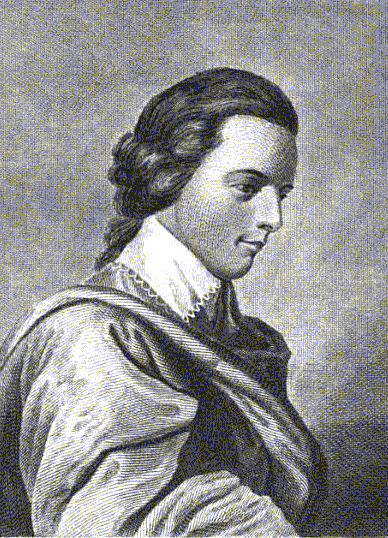
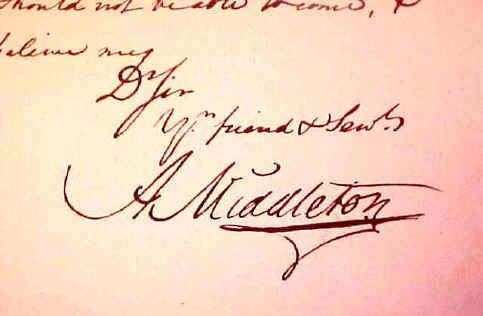
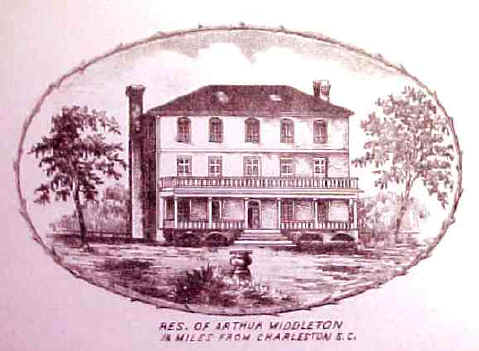
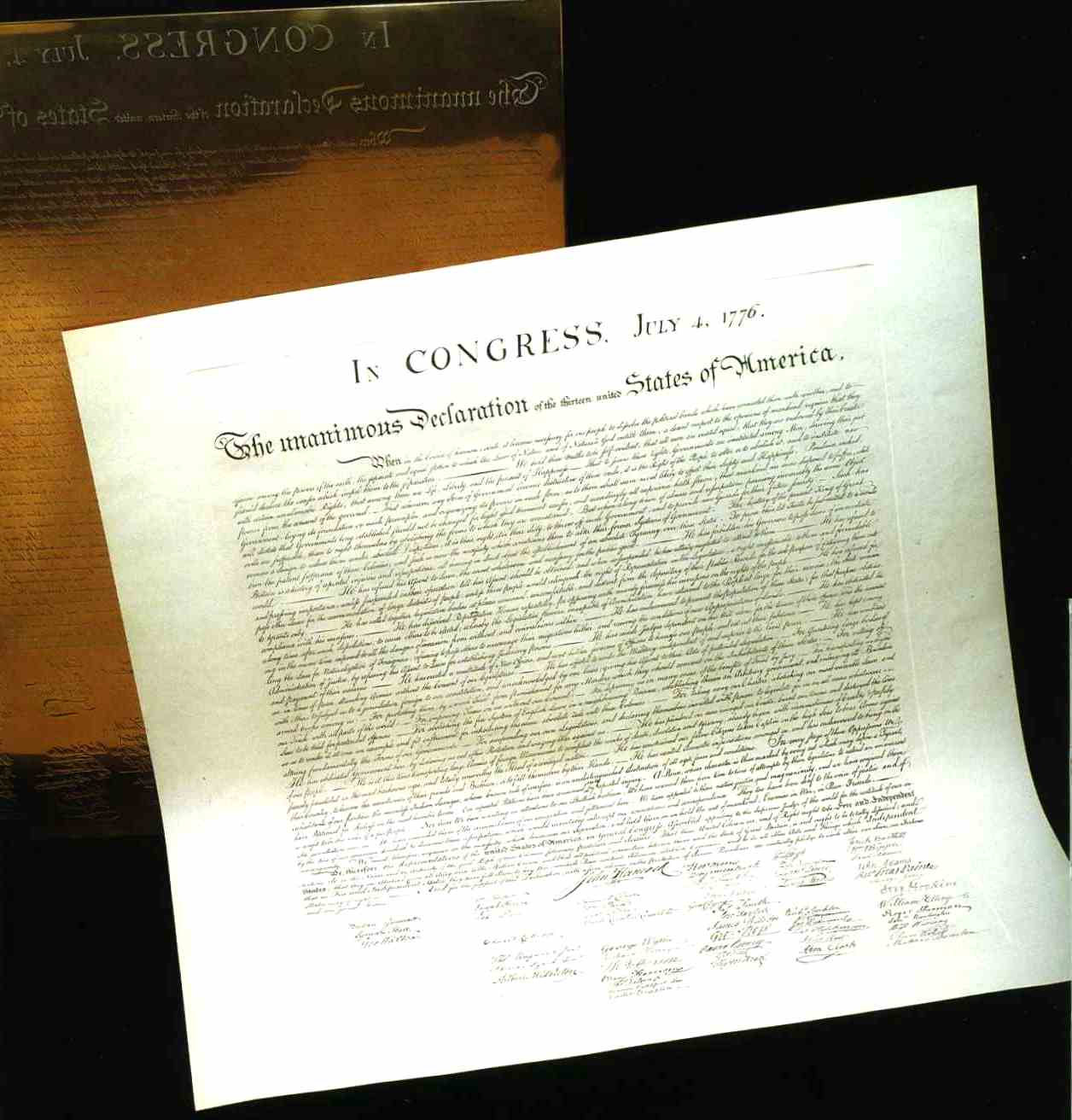
Arthur Middleton (June 26, 1742–January 1, 1787), of Charleston, South
Carolina, was a signer of the Declaration of Independence.
Arthur Middleton
Signer of the Declaration of Independence
ARTHUR MIDDLETON the eldest son of Henry
Middleton was born on June 26, 1742, at the family mansion Middleton Place, on
the banks of the Ashley River near Charleston, South Carolina. Middleton was
twelve when his father, the president of the First Continental Congress, sent
him to England for his education. He studied at Hackney, in London, for two
years and then moved on to Westminster. He received a thorough education in the
Greek and Roman classics, especially the former in which he is said to have
greatly excelled. The taste that he acquired for classical literature he
preserved through his life. Middleton then went on to Cambridge. His college
companions were frequently young men of dissipated habits, and young Middleton
was often powerfully tempted to enter into their youthful follies. Fortunately
he escaped the corruption of their insidious examples, and devoted himself to
the improvement of his mind. In his twenty-second year, he was graduated
bachelor of arts, and left the university with the reputation of an accomplished
scholar, and a moral man.
Arthur did not return to America upon his graduation. Because of his father's
wealth, he was able to travel extensively. After visiting several parts of
England, he proceeded to the continent, where he spent two years, chiefly in the
southern parts of Europe. He spent several months in Rome, greatly improving
his taste for music and painting. He even became well versed in the principles
of sculpture and architecture.
Soon after returning to South Carolina in 1763, he married Mary, the daughter of
Walter Izzard, Esq. Arthur became a justice of the peace and served as a
delegate to the provincial assembly. However, still having a fondness for
traveling, he and his wife again embarked on an extended visit to Europe in
1768. This time they visited many places in England, and proceeding to the
continent, they passed through several of the principal cities of France and
Spain.
In
1773, Middleton once more returned to America, and now settled down on the
delightful banks of the Ashley at Middleton Place, where he acquired vast rice
plantations. The Middleton's were at this time, men of great wealth, and the
approaching controversy between Great Britain and the colonies might have been
viewed with great concern, had not their patriotism preferred the welfare of
their country to their private interests. A war with Britain would jeopardize
the wealth that had long been enjoyed by the family. Both father and son, in the
spirit that had long characterized the family, stood forth in the defense of the
rights of the colonies.
In May
1776, Middleton joined the Second Congress and championed the cause for colonial
rights. He actively opposed British rule despite his obvious love for the mother
country. Despite his English education, he was ruthless toward Loyalists. Like
other leaders in South Carolina, he was motivated chiefly by local
patriotism. He was a member of the council of safety that virtually ruled the
province until a provisional government was set up in the spring of 1776, and he
was a member of the large committee that drew the constitution for South
Carolina. His activity in these provincial affairs delayed his departure for
Congress. In May 1776, Arthur Middleton took the seat vacated by his father. He
was re-elected the next year but never spent much time in Philadelphia
sessions. He spoke frequently when present but did not like routine business. At
the close 1777, Middleton relinquished his seat in Congress, and returned to
South Carolina, leaving behind him, the character of a man of the purest
patriotism, of sound judgment, and unwavering resolution.
During the year 1779, the southern states became
the principal theater of the war. Many of the plantations were needlessly
raided, and the families and their personal property were open to the insults
and devastation of the enemy. Middleton Place did not escape. Although the
buildings were spared, they were looted of every thing valuable. Anything that
could not be easily carried was either destroyed or greatly damaged. Middleton
owned a valuable collection of paintings that was mutilated by the advancing
march of troops. Fortunately, the family had made their escape north of
Charleston before the British visited Middleton Place.
Middleton was actively engaged in the defense of
Charleston in 1780. With several others he was taken prisoner, and was sent by
sea to St. Augustine, in East Florida, where he was kept in confinement for
nearly a year. In July 1781, he was exchanged, and proceeded in a cartel to
Philadelphia. In November 1782, he returned to South Carolina on a visit to his
family, from whom he had been separated for along and anxious period.
On the signing the preliminaries of peace,
Middleton declined accepting a seat in congress, preferring the pleasures of
retirement with his family. He occasionally accepted a seat in the state
legislature, in which he was greatly instrumental in promoting the tranquility
and happiness of his fellow citizens.
In
the winter of his forty-fifth year, 1786, Middleton contracted a
fever. Middleton died on January 1, 1787. --
Appletons Encyclopedia
Arthur Middleton, the son of Henry Middleton, a weal- thy
planter in South Carolina, was born in 1743, in Middleton Place, a name given it
by the family, who first settled in south Carolina.
At an early age he was sent to England for his education. His first station was
the school at Hackney, in which several of the members of the early congress
from the south received .'heir preparatory instruction to fit them for the
university. After spending the necessary term in that school, with exemplary
application, he was transferred at fourteen years of age for a school in
Westminster. Here he remained about four years, and then entered the university
of Cambridge. Although amply supplied by his father with the means of indulging
in the dissipated habits of the gay, he rather chose to attend to his studies,
and preserve a moral and sober deportment; shunning those places where the young
and thoughtless are but too easily allured, and often ensnared to thou ruin.
After spending four years there, with much credit to himself, he took his degree
in the twenty-second year of his age. He left that seminary with a good
reputation, as a sound scholar, and a man of correct morals. He spent some time
after this, in visiting various places in England, and in reviving and
strengthening the feelings of affectionate attachment, which had subsisted from
the beginning, between the branch which had emigrated to America, and those who
remained in England. From thence he passed over to the continent, and commenced
a tour in Europe. In this tour, which was principally in the southern parts of
Europe, he spent nearly two years. In this time, he passed several months in
Rome, improving his mind by studying the fine arts, for which he had a relish,
and in which he became somewhat of a proficient. He then returned to South
Carolina and was soon married to Miss Izard.
About a year after his marriage, he embarked for Europe with his young wife,
whom he resolved to gratify with an opportunity to see England, and an excursion
on the continent In this tour he visited several of the most celebrated places
in France and Spain. Having gratified her with a view of foreign countries and
customs, they returned again to his na- live place in 1773, and took the family
seat for their residence, which his indulgent father gave up to his favored son.
There, in possession of wealth, he had as fair a prospect could open to the
young mind, of enjoying every satisfaction that this world can furnish; but this
prospect scarcely opened to his view before it began to be overcast.
In 1774, the cloud began to collect, indicating the storm which in the year
following burst on New England, and agitated the whole of the North American
colonies. The time had now arrived when it became necessary for men to declare
themselves openly. Neutrality was inadmissible. In this time Henry and Arthur
Middleton, father and son, with nothing to gain for themselves should the cause
of the colonies succeed, and much to lose if it failed, without hesitation
decided for their country; and stepping forth boldly, put on the badge of
independence.
From this time Arthur Middleton was actively employed in various ways, in
promoting the cause of the colonies, which had become both interesting and
critical. He entertained no half-way measures, but took a firm and decided stand
in op. position to British encroachment and oppression.
He was a member of various committees, which were entrusted with great powers;
and who enjoined to " Take care that the republic receive no detriment." He was
in April, 177-5, appointed with four others a committee, to place the colony in
a state of safety against its enemies. They took possession of the public
magazine of arms and ammunition, and removed them from the custody of the
officer having them under his charge, and appropriated them to the use of the
colony.
In June following, he was appointed one of a large committee, by the provincial
congress of South Carolina, to watch over, and take such measures as they might
deem necessary, in that trying emergency, for the public safety. Of that
committee he was an active and leading member. Afterwards, when Lord William
Campbell was appointed governor of South Carolina, although he was nearly
connected by marriage with Mrs. Middleton, and it was discovered that he was
playing a double game with the members of the provincial congress, Mr.
Middleton, waving the influence of family connection, at the hazard of a
friendly intercourse which then subsisted between his family and the governor's,
proposed that he should immediately be arrested, and taken into custody. This,
though it was overruled by a majority ot the committee, less decided than he,
was undoubtedly a wise and politic proposal; and had it been carried into
execution, it would probably have saved South Carolina from much trouble which
was shortly afterwards endured, by reason of Lord Campbell's fleeing, and
returning with an armed force, under Sir Henry Clinton and Sir P. Parker, to
invade and ravage their coasts.
Mr. Middleton was chosen one of a committee of eleven, to devise a form of
government for South Carolina, during the contest with Great Britain. This was
in the winter of 1776 In a short time he was chosen one of the representatives
for South Carolina, in the congress of the nation, then in session at
Philadelphia. This was the congress which declared in- dependence, for which Mr.
Middleton voted, and to the declaration of which he set his hand, with a
prospect of sacrificing large possessions, an estimable family, and even life
itself, should the contest terminate unsuccessfully for his ' country.
He continued a member of congress, residing with his family which he took with
him, until the close of 1777.
In 1778, the assembly having adopted a new constitution, in conformity to the
recommendation of congress, chose Ar. thur Middleton their first governor under
it. This was done not only without his soliciting it, but without his having
even contemplated the event as possible.
But Mr. Middleton, as Mr. John Rutledge before him had done, doubted the
legality of the proceedings of the legislature, which formed the constitution,
and declined an acceptance of the appointment; and this he did in a manner which
raised him still higher than before in popular opinion. The people approved of
his motives, although they might hare thought him incorrect in his judgment.
In 1779, when the British invaded the South, under General Provost, Mr. John
Rutledge having been called to the chair of state, undertook to defend
Charleston against the enemy. Although Mr. Middleton's property was entirely
exposed to their depredations, and without any protection, he joined the family
of Governor Rutledge, and entered Charleston with the troops assembled there for
its defense. He united his personal exertions with others to protect that city
and had the happiness of seeing the enemy retreat, without attacking the place.
In the exposed condition of his own property, he only wrote to his wife to
remove his family a days journey out of the scene of immediate danger. Thus,
while he exerted himself for the protection of others, he left his own property
to be ravaged by an enraged foe. His loss was very great by that irruption of
the British.
In the following year, he, with many other gentlemen of distinction, was taken
prisoner by Sir Henry Clinton, and sent to St. Augustine as prisoners of war.
Mr. Middleton was then engaged as a private soldier, in the defense of
Charleston. When in the year following these prisoners were exchanged, and sent
in a cartel to Philadelphia, he was appointed a representative of South Carolina
in Congress. He was again elected to that office by the general assembly in
1782. This was in the beginning of the year. He continued to occupy his seat
till November, and then returned to his family, from whom the vicissitudes of
war, and the calls of public duty had long separated him.
The contest being now brought to a close, by the capture
of Lord Cornwallis, and the preliminaries of peace having been made known in the
United States, Mr. Middleton declined serving his fellow citizens any longer in
congress. He however consented to represent them in the legislature of the
state, and was a very influential and highly useful member of that body, at a
period when the state was much agitated by various causes which such a state of
things might naturally be expected to produce. The influence of the best men the
state could furnish, was needed to allay these unhappy difficulties, and restore
harmony to the disturbed community. For this purpose, Mr. Middleton devoted his
best efforts.
Besides his services in the legislature, he entered into no public employment,
but spent his time with his family, resi- ding principally in a country
residence, a short distance from Charleston. There he received his friends with
kindness, and treated them with that hospitality for which southern gentlemen
have with justice been honorably distinguished. But he did not continue long to
enjoy the blessings of peace and civil liberty, for the attainment of which he
had made o many sacrifices.
in the autumn of 1787, he contracted an intermitting fever, by incautiously
exposing himself. This he left to commit its ravages on his constitution,
thinking that " the power of nature" was adequate for affording relief. He
neglected to call for medical aid until his health was so far undermined, that
when it was applied, it came too late to furnish relief. He died on the first of
January. 1788, about fifty-five years of age.
Mr. Middleton, at his death, left a wife and eight children ; two sons, and six
daughters. Mrs. Middleton survived him until 1814, retaining that rank and
esteem in the most polished society, to which she was well entitled. Henry, one
of his sons, after having been governor of the state, and a member of the house
of representatives in congress, was appointed minister to the court of Russia.
-
-- The Lives of the Signers of the Declaration
of Independence, By Nathaniel Dwight, Published by A.S. Barnes & Co., 1860,
Edited by Stanley l. Klos 2000
Unauthorized Site:
This site and its contents are not affiliated, connected,
associated with or authorized by the individual, family,
friends, or trademarked entities utilizing any part or
the subject's entire name. Any official or affiliated
sites that are related to this subject will be hyper
linked below upon submission
and Evisum, Inc. review.
Please join us in our mission to incorporate The Congressional Evolution of the United States of America discovery-based curriculum into the classroom of every primary and secondary school in the United States of America by July 2, 2026, the nation’s 250th birthday. , the United States of America: We The
People. Click Here