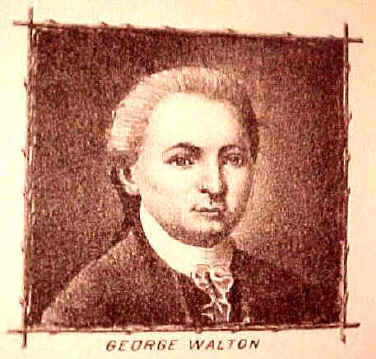
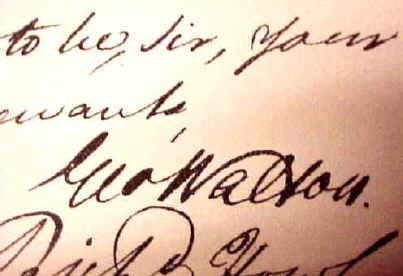
George Walton (1749 or 1750–February 2, 1804) signed the United States
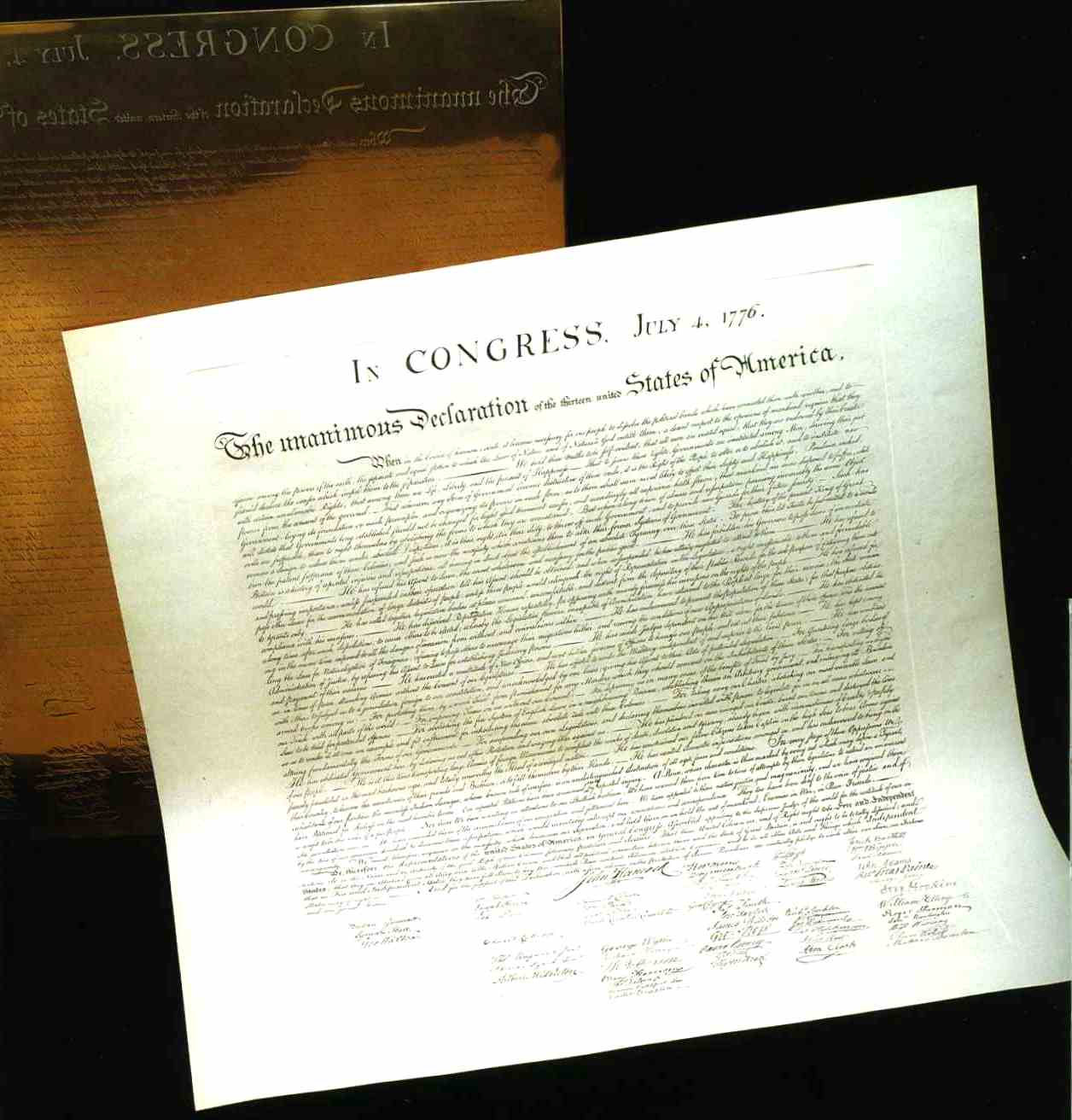
Declaration of Independence as a representative of Georgia and also served as
Governor of that state.
George Walton
Signer of the Declaration of Independence
GEORGE WALTON was born in Frederick county,
Virginia in 1741 and was left an orphan when still a small child. His uncle
reared him until he was old enough to be apprenticed to a carpenter. Walton was
entirely self-taught; his employer would not permit him the use of a candle to
read at night, but in his zeal for knowledge, Walton found a substitute in pine
knots. When his master realized that young Walton had other talents worth
pursuing, he released Walton from his contract. Walton moved to Savannah Georgia
and studied law with Henry Young. He was admitted to the bar in 1774 and began
his practice at Augusta.
While
Georgia for the most part remained loyal to Britain, Walton zealously supported
the cause for independence and did not hesitate to make his feelings known in
business or social circles. Walton was one of four people who called a public
meeting at Savannah on July 27, 1774, for the purpose of hearing public
grievances against the crown and he was one of a committee that was appointed on
that occasion to correspond with the other colonies in opposition to the British
government.
In 1775, Walton married Dorothy
Camber and they eventually had two sons. That same year he was also chosen as
president of the newly created council of safety. Early in 1776, Walton was sent
to the Continental congress and he quickly gained recognition and the respect of
his colleagues. He was re-elected the following October and until October 1781,
he continued to represent Georgia. Walton favored a strong central government
for America and it was this conviction that led to his friendship with Robert
Morris and George Clymer. When the Second Congress had to retreat to Baltimore,
Morris, Clymer and Walton remained in Philadelphia, risking capture by the
British, and created an effective, informal war office. In December 1778,
Walton was appointed a colonel in the militia, commanding a battalion on the
right of General Robert Howe's army when the British took Savannah. Walton was
wounded in the thigh, fell from his horse, and was taken prisoner by the British
troops. A brigadier-general was demanded in exchange for him, but in September
1779, he was exchanged for a captain of the British Navy.
In October 1779, Walton was
appointed governor of Georgia for several weeks before the British took it
over. He was appointed chief justice of the state in 1783, and he held other
judicial posts, being a notable supporter of law and order in his rather
turbulent state, that was then in a frontier stage. In 1789 he was elected again
governor of Georgia and in the last decade of his life he filled an un-expired
term in the United States Senate.
During the latter years of his life,
Walton suffered intensely from frequent and long attacks of gout, which probably
contributed to his death. He died at Meadow Garden, his home in Augusta Georgia
on February 2, 1804.
Probably the future historians of the United States of North America will justly
consider, as a fact worthy of record in the national annals, the large
proportion of self-educated men, who were found among the leading revolutionary
patriots, both in civil and military life ; and especially of the individuals
who composed that congress which declared the nation free and independent. It is
certain that several of them in their youth enjoyed but limited advantages; even
of those who were placed at schools by their parents, by reason of the small
advantages which those schools could afford. Yet these were liberally furnished,
compared with some of their colleagues, who made a distinguished figure in
public life, were eminently useful to the national councils, and attained to the
highest honors, and the most important offices that their several communities
had the power of conferring on their ablest citizens. These remarks are elicited
by an attention to the history of the life of the gentleman, whose name stands
at the head of this article.
George Walton, the subject of this memoir, was a native of Virginia, and born in
Frederick county, about the year 1740. His parentage was obscure ; and probably
in limited pecuniary circumstances, he having been placed as an apprentice to
learn the business of a carpenter. At the proper and most appropriate age for
commencing the education of youths, what his advantages were we are not
particularly informed ; but he was not entirely destitute of instruction. For
during his term of service, though his master would allow him neither time by
day, nor lights by night, that he might devote what time he could spare from
labor, to books; we learn thai he did contrive to cultivate, and improve his
mind by reading. For this purpose, he collected torch-wood, and a portion of the
night, after the labors of the day were closed, was spent by him in study. He
had therefore not only learned to read, but he had a very ardent fondness for
it.
His subsequent life supplied him with no other classical advantages, than what
he derived from the resources of the own unaided exertions. Notwithstanding all
these impediintuits, which would have disheartened the resolution of most
youths, he persevered in this manner in improving his mind by reading such books
as he could procure, to the close of his apprenticeship. And when he was
released from the obligation of his indentures, he was possessed of such a share
of knowledge, practical, and theoretical, that he removed to the province of
Georgia, and commenced the study of Jaw with Henry Young, Esq.; a gentleman
whose character, both professional and political, was distinguished in that
colony.
Mr. Walton commenced the practice of law in 1774, at the time when opposition to
the oppressive proceedings of the English parliament, relative to the American
colonies, was maturely organized in all -the provinces, except South Carolina
and Georgia. But even in Georgia, though generally almost stagnant, it was
commenced, and advancing onward to a state of maturity in some districts,
excited and direct. ed by some leading men of decided patriotism, and superior
intelligence. With some of these Mr. Walton was associated, and those kindred
spirits determined to rouse the whole people of that province, to feel and act
with the patriotic inhabitants of the other colonies, notwithstanding the
counter influence they had to combat. Mr. Young, law preceptor of Mr. Walton,
was a decided advocate for the royal cause. But his independent mind would not
be controlled, nor even influenced to act against his own views of right. Nor
would he yield to any inducements which the state of the times presented, to
allure young men of decided talents and influence, even to forbearance or
neutrality. The rights of his fellow citizens were jeopardy; and the times
demanded decision, and active exertions from all their friends, to vindicate and
defend them against lawless usurpation, under whatever sanctions it might be
attempted. Mr. Walton therefore voluntarily sacrificing all the flattering
prospects placed in his view, and proffered as a reward for his adhesion to the
royal interest, united with other gentlemen of similar feelings, in lending an
open opposition "to the then ruling powers of Georgia, and committed his rising
hopes and fortune, amid no small danger to the very problematical issue of a
controversy, in which the vote of a rebel against his rightful sovereign might
be the consequence. He took his position on the side of the colonies, and
undeviatingly pursued the straight forward course which that indicated.
The parlies were now clearly defined, and in open opposition ; although the
patriots were, hitherto, but a feeble minority when numerically considered.
Their measures were opposed, and greatly embarrassed by the temporizing policy
of the royalists. But they were not to be frustrated; and by a resolute
perseverance, they at length succeeded in obtain ing a decided majority in the
legislative assembly in their fa vor; and this event was, undoubtedly hastened
forward, by the result of those measures which their opponents pursued with the
British parliament. The contemptuous and negligent treatment they experienced,
and the unceremonious rejection of their petitions and remonstrance by
parliament, wrought a counteraction, and roused a spirit of determined
opposition and resistance, in many, who a short time previous, were in favor of
a cautious, timid, and temporizing policy. They soon united with those who had
been forward in Georgia ; and they together, brought the colony to act in unison
with all the other provinces, in making resistance a common cause throng!) the
thirteen American colonies. Immediately a committee ff safety was organized in
Georgia, to superninend and manage the concerns of the patriotic party; and to
hold correspondence with similar committees in other colonies. The next and
deciding measure, was soon adopted. The convention of Georgia acceded to the
general confederacy, and elected their delegates to the continental congress.
Opposition to the British influence and authority soon' attained its zenith in
Georgia. A majority of the legislature were so strongly indignant at the
treatment they had experienced from the parent government at home, that they
totally disregarded the communications made to that body by Governor Wright.
They appointed Archibald Bullock, a resolute man, and a decided patriot,
president of the executive council. He had already, with four colleagues, been
elected a delegate to congress. This act of the legislature, together with the
en. tire disregard his communications met with, so incensed the royal governor,
that he threatened to resort to military force, to compel them to act. The
suggestion so manifestly implied in that menace, increased their indignation to
such a degree, that they resolved to seize on his person, and hold him in
custody. This having been effected, and the governor having forfeited his honor
by breaking his parole, the regal power in Georgia was prostrated ; and the
confederated hostilities with the parent state, was completed by embracing the
whole of the thirteen provinces. In effecting this consummation, so long and so
ardently desired, Mr. Walton stood forward with the other leading characters,
and actively used his best exertions.
Mr. Walton was appointed for the first time a delegate to congress, from
Georgia, by the state legislature, the beginning of February, 1776. He was again
honored by a re-election to the same office, in October following. He reached
Philadelphia on the last day of the session of congress, before they adjourned
to Baltimore, to avoid the danger of being captured by the British army, who
were approaching that city. At the time of their adjournment, it was highly
necessary to have a committee remain in Philadelphia, invested with an important
trust, requiring them to transact business of much, interest to the public. This
committee consisted of Messrs. Clymer and Morris of Philadelphia, and George
Walton of Georgia. He was appointed on the third day after his arrival. This was
a testimony of the confidence reposed in him by congress, which, under all the
circumstances connected with his previous history, was highly honorable to his
uhameter, and must have been grateful to his feelings. Their principal trust was
of great pecuniary value, and connected with other duties of a delicate kind.
But, important and delicate the trust was, it was discharged to the entire
satisfaction of congress. Indeed, peculation and frauds by public officers, in
that age of stern virtue, would have fastened of their perpetrator such an
indelible stain, as would have ruined them forever, in the estimation of the
whole community.
He was successively re-elected to congress in the years 1777, 1778; and again in
1780. He was placed on the marine committee, appointed a member of the treasury
board, and placed on several committees of minor importance by congress; in
performing the duties of which he was a vigilant and active member, always
evincing much useful intelligence, and great zeal in behalf of the cause he had
espoused. While performing his civil functions in the great council of the
nation, whose independence he had advocated and proclaimed, he was placed in
military rank, in the year 1778, and appointed to the command of a regiment of
militia. He appeared at the head of a battalion in General Howe's army, when
Savannah was attacked by the British. In that engagement, while gallantly
leading the troops under his command, to defend the place, he received a wound
through his thigh, fell from his horse, and was taken prisoner by the enemy. He
remained on parole until recovered from his wound, and then was sent as a
prisoner of war to Sunbury. He was afterwards exchanged, and although his rank
was no higher than a colonel, and the grade in which he served when taken
captive, only that of a major, yet because he was at that time a member of
congress, and because he had committed the heinous crime of setting his
signature to the Declaration of Independence, the British government demanded in
exchange, as an equivalent, a brigadier general. But after they had learned that
his term in congress, for which he had been elected the last time, expired
during his captivity, they consented to receive in exchange, a captain of their
navy for him, who was a lieutenant colonel.
While the British continued to hold possession of Savannah, after the
unsuccessful attack of combined forces, under Major General Lincoln, and Count
D'Estaing, the legislature of Georgia, in October, 1779, appointed Colonel
Walton governor of the state. He did not,' however, retain that office lung; for
on the close of the session in Augusta, in January, 1780, he was again elected a
member of congress for two years. But in October of the following year, he
finally withdrew from congress, in whose counsels he had so long and so
faithfully displayed his unbending patriotism, in promoting the cause, and
advancing the final establishment of his country's independence and liberty.
By means of some imprudent conduct of President Gwinnett, during his short but
brilliant course of public life, a jea-x lousy had risen between him on the one
part, and Colonel M'Intosh and a few partisans on the other, which was
productive of disastrous consequences in that community, and eventually caused
Mr. Gwinnett to fall in a duel, an early victim to false honor. This discordant
spirit had extended wide in the society of Georgia; and, for a time, seemed to
threaten a total destruction of all harmony in the state. There seems to have
existed a mutual jealousy and animosity on both sides. From the unhappy
consequences of that state of public feeling, Governor Walton did not escape. He
was seriously inculpated, as was supposed, by Gen. M'Intosh. But whether justly
or unjustly, remains, and probably will remain undecided. We would willingly
withhold the narrative ; but historical justice and truth, require that it
should be stated.
As General M'Intosh had become very unpopular with those who supported the civil
power, so he was very popular with his adherents. He was in truth their leader,
who kept the feud in commotion. The members of congress from Georgia, fearing
the consequences of this state of parties, united in an application to the
commander in chief, to assign General M'Intosh to another command out of the
state, and supply his place with another officer of equal rank. The change was
effected. General M'Intosh was ordered to join the grand army; and General Howe
to take his place. The evil was not allayed, however, by this means; and the
breach was yet far from being closed.
A party was formed in Savannah, whose avowed object it was to prevent the
military power from encroaching on the civil. They assumed the popular name of "
The Liberty Club." It had several branches in the different counties, which
taking direction from that in Savannah, all acted in concert. This club, at
length, attained to such power as to be able to control all appointments to
offices in the state. During the time Colonel Walton acted as governor of
Georgia, in 1779, a letter was forged by somebody, and transmitted to the
president of congress, under signature of the speaker of the house of
representatives ; which, by fair implication bore hard on the character of
General M'Intosh. The speaker declared it a forgery. General M'Intosh charged
Colonel Walton with a connivance in the imposture, because he gave credit to its
contents, when in congress. He considered himself as unjustly accused, and much
injured, by those concerned, in his military reputation. The matter, with the
proofs, were laid before the legislature of Georgia, and they seemed to be
embarrassed with the subject. To appease General M'Intosh, they recommended to
the attorney general, to institute a prosecution against Governor Walton before
the supreme court of that state, and passed a vote, censuring his conduct. At
the same time, or rather on the preceding day, that same body had appointed him
chief justice of the state, and placed him at the head of the only tribunal
which could take cognizance of the complaint. Such an inconsistency do the
records of that legislative body present. It is probably to be explained in-this
manner. The times were critical. M'Intosh was an influential officer, whom they
wished to pacify ; and for that purpose took this measure. At the same time they
placed Governor Walton out of the reach of the complaint, by putting him at the
head of the only court which held jurisdiction in the case. General M'Intosh and
Judge Walton, were at that time respectively at the head of the civil and
military departments in Georgia.
Mr. Walton had thus risen, as we have seen, from the condition of a carpenter's
apprentice without education, to the highest honors and offices in the gift of
the state ; and, from this time, until his death, he held the most respectable
appointments which the people of Georgia could bestow on him.
Six times he was elected to congress ; twice governor of Georgia; once a senator
of the United States, and a judge of the superior courts. He retained this last
mentioned office during the term of fifteen years. In addition to these, he was
one of the commissioners appointed by the United States, to negotiate a treaty
with the Cherokees in Tennessee ; and he was also several times a member of the
state legislature of Georgia.
Mr. Walton was married, in 1777, to Miss Camber. Their only issue was one son,
who bore the name of his father. And when General Andrew Jackson was governor of
West Florida, Mr. Walton held the office of secretary of state ; the duties of
which station he fulfilled to the acceptance of the general government.
Mr. Walton was eons'' -a ardent temperament, -warm both in his attachments and
enmities. One prominent characteristic of the man was decision. He partook not
at all of a temporizing disposition. In his manner generally, he was stern, and
kept the world rather at a distance. But he was attentive to merit; and towards
young men of talents and genius he was respectful, and treated them with such
amenity and kindness, as encouraged them to go forward with confidence in their
honorable pursuits, lie possessed a native vein of satire, which he at times
indulged with much effect. It is said of him, however, that he had this
dangerous weapon under such thorough discipline, that he rarely indulged it in a
way which gave offence to any. His manner of living was such, as subjected him
to an early attack of the gout; which followed him with successive paroxysms,
and an increasing severity to the close of his life. His desire for information,
which so strongly marked the morning of his life, was perpetual; and when
suffering under the excruciating attacks of his disease, he found, as he used to
remark to his physician, " a book the most effectual remedy for mitigating his
anguish."
Mr. Walton never accumulated wealth, as he seemed not to have sought for it, as
necessary for his happiness. He lived contentedly, on the emolument of his
offices, and the produce of a small farm. He was able, by these means to sustain
the dignity of his official station, according to the views ant! estimation of
the society with which he was connected. It was a fixed sentiment with him,
never to suffer an office which he held to be degraded by the incumbent, in his
style of living, or by submitting to any treatment which would be deemed
disrespectful to official dignity.
He closed his eventful life on the second day of February, 1804, in the city of
Augusta, in Georgia ; leaving in his enterprise and attainments, under many
embarrassments, an instructive example to youths of aspiring minds, and to hia
country an honorable character, whose duration will bo coeval with its
independence and prosperity. --
The Lives of the Signers of
the Declaration of Independence, By Nathaniel Dwight, Published by A.S. Barnes &
Co., 1860, Edited by Stanley l. Klos 2000
Declaration
of Independence
A Brief History and early record of
the printings
Unauthorized Site:
This site and its contents are not affiliated, connected,
associated with or authorized by the individual, family,
friends, or trademarked entities utilizing any part or
the subject's entire name. Any official or affiliated
sites that are related to this subject will be hyper
linked below upon submission
and Evisum, Inc. review.
Please join us in our mission to incorporate The Congressional Evolution of the United States of America discovery-based curriculum into the classroom of every primary and secondary school in the United States of America by July 2, 2026, the nation’s 250th birthday. , the United States of America: We The
People. Click Here