Princess
Sophie Charlotte of
Mecklenburg-Strelitz was born on May 19, 1744, the eighth child of the Prince of
Mirow, Charles Louis Frederick, and his wife, Elisabeth Albertina of
Saxe-Hildburghausen.In 1752, when she was eight years old, Sophie Charlotte's father
died.In
August of 1761,Charlotte's brother, Adolf Frederick IV and Sophie
Charlotte's dying mother signed her marriage contract with the English
King George III of the House of Hanover. At the age of 22, the King had
chosen the 17-year-old Strelitz princess as his bride.
When
George III first received his young bride on September 9, 1761, at the
garden gate of St James's Palace, he was supposedly was shocked by her
lack of beauty. It became evident, though, that the pious and modest
Strelitz princess soon conquered his heart and willingly submitted to
his strong influence over her.
In
the first twenty-one years of her marriage Queen Charlotte gave birth to
fifteen children, nine sons and six daughters. In contrast to most
European Royal houses George III and Charlotte had a harmonious
marriage. Charlotte played a prominent, though reticent, role on the
stage of European world history. As Queen of England and consort of
George III she became an eyewitness of a turbulent age.
On
the other hand, during their lifetimes the English court had the
reputation of being the dullest in all of Europe because of their
notoriously frugal, plain, and pious life-style. Their charities,
however, were legend. Hospitals such as the famous Queen's Lying-in
Hospital in London which was founded by Charlotte, orphanages,
"decayed" musicians, and untold poor families could rely on
their patronage. Eight-year-old Wolfgang Amadeus Mozart fulfilled Queen
Charlotte's request and dedicated his Opus 3 to her. When her court
musician and music teacher Johann Christian Bach died of consumption, she paid for hisfuneraland established a pension for his widow.
In
1788, a shadow fell on the happiness of the Royal family. It became
evident that George III had started his slow and violent descent into
the madness caused by the inherited malady porphyry.His suffering lasted for thirty years until his death in 1820.
The Royal Marriage Act, pushed through Parliament by George III in 1772, placed another heavy burden on his family. It stipulated that none of
his descendants could marry before the age of twenty-five without the
King's consent, and even then they might only marry Protestant princes
or princesses. The result of this rather strange law was that his
children sought refuge in secret marriages and illicit love affairs or
stayed unmarried. Queen Charlotte's court in later years was also called
"The Nunnery."
Her
oldest son George, Prince of Wales, finally was named regent in 1812, at
the age of fifty and, in 1820, upon the death of his father, ascended
the throne as George IV, King of Great Britain and Hanover. The
"regency of the person" of the ill king George III remained in
the hands of his loyal Queen Charlotte until her death on November 17,
1818, at Kew Palace.
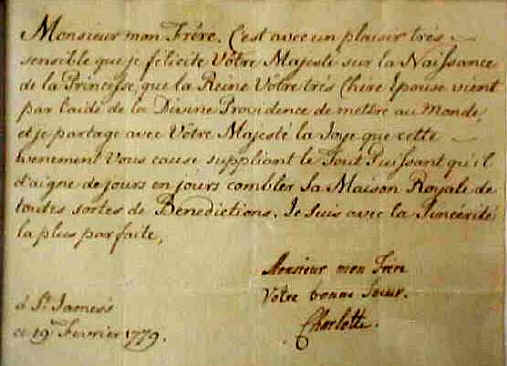
A war date autograph letter signed to her brother written in French."Sir my brother. It is with great pleasure that I
congratulate Your Majesty on the Birth of the Princess, that Rieneyour very lovely wife comes by the assistance of Divine Providence to
put the World, and I share with Your Majesty the joy that this event
causes you begging the Quite Powerful that it of a aigne from days to
days to fill the royal house with all kinds of Benedictions.With my perfect sincerities.Sir my brother, Your good sister, Charlotte. At St. James, 19th February 1779."
Unauthorized Site:
This site and its contents are not affiliated, connected,
associated with or authorized by the individual, family,
friends, or trademarked entities utilizing any part or
the subject's entire name. Any official or affiliated
sites that are related to this subject will be hyper
linked below upon submission
and Evisum, Inc. review.
Please join us in our mission to incorporate The Congressional Evolution of the United States of America discovery-based curriculum into the classroom of every primary and secondary school in the United States of America by July 2, 2026, the nation’s 250th birthday. , the United States of America: We The
People. Click Here